O Brasil recua de si mesmo, briga contra si mesmo e, mais uma vez, como tem acontecido, perde para si mesmo. Seguindo, obediente, a decisão do presidente dos Estados Unidos, o presidente brasileiro ameaçou retirar o país do Acordo de Paris, voltou atrás, voltou atrás de traz, e até agora estamos sem saber de que lado do círculo de indecisões estamos.
Logo no início do mandato do atual governo federal, os encontros sobre mudanças climáticas, agendados para acontecerem aqui, foram transferidos para outros países, porque o governo se recusou a sediá-los.
Seguindo, obediente, a decisão do presidente dos Estados Unidos, o presidente brasileiro ameaçou retirar o país do Acordo de Paris, voltou atrás, voltou atrás de traz, e até agora estamos sem saber de que lado do círculo de indecisões estamos.
Enquanto isso o planeta esquenta e a Amazônia queima.
Mas não temos um planeta B, como gritado nas ruas de Nova York na manifestação de 250 mil pessoas que, juntamente com outras em vários países, antecedeu, em setembro, a Cúpula do Clima da ONU, convocada pelo secretário-geral, António Guterrez.
Calcula-se em 4 milhões de pessoas a presença nas diversas manifestações que deram força e sonoridade militante ao movimento “Frydays for Future”, iniciado como protesto silencioso, em agosto do ano passado, e que se alastrou pelo planeta como a consciência indomável da juventude que não quer ver o planeta sucumbir aos desmandos econômicos e financeiros de governos da minoria que concentra, de forma desigual e injusta, a maior parte de toda a riqueza do mundo.
Ao desequilíbrio ecológico e ambiental corresponde, em proporções semelhantes, o desconcerto social, econômico, político e cultural que embasa a desarmonia da vida contemporânea.
É o que aponta, por exemplo, a Pesquisa Nacional por Amostra de Domicílios Contínua (Pnad Contínua) aplicada no Brasil, desde 2012, pelo IBGE. Segundo a pesquisa, cerca de 104 milhões de brasileiros, metade da população, vivia em 2018, com R$ 413,00 por mês e o 1% mais rico ganhava 40 vezes mais do que isso.
O problema, ainda maior, é que o país está retrocedendo e, sobre os escombros das ruínas que se anunciam, o governo alardeia, tartamudeando imprecações, a balela ideológica da confusão mental como clarividente revelação da nova Canaã.
Não há como tergiversar com a questão das mudanças climáticas e com o tema das desigualdades sociais. Não há ideologia, não há interesses que se sobreponham à manifestação simples, direta, objetiva e sincera de todos que se unem e em uníssono proclamam: Não há planeta B!
A man uses a garden hose to try to save his home from wildfire in Granada Hills, California, on 11 October 2019. Photograph: Michael Owen Baker/AP
The world’s people face “untold suffering due to the climate crisis” unless there are major transformations to global society, according to a stark warning from more than 11,000 scientists.
“We declare clearly and unequivocally that planet Earth is facing a climate emergency,” it states. “To secure a sustainable future, we must change how we live. [This] entails major transformations in the ways our global society functions and interacts with natural ecosystems.”
There is no time to lose, the scientists say: “The climate crisis has arrived and is accelerating faster than most scientists expected. It is more severe than anticipated, threatening natural ecosystems and the fate of humanity.”
The statement is published in the journal BioScience on the 40th anniversary of the first world climate conference, which was held in Geneva in 1979. The statement was a collaboration of dozens of scientists and endorsed by further 11,000 from 153 nations. The scientists say the urgent changes needed include ending population growth, leaving fossil fuels in the ground, halting forest destruction and slashing meat eating.
Prof William Ripple, of Oregon State University and the lead author of the statement, said he was driven to initiate it by the increase in extreme weather he was seeing. A key aim of the warning is to set out a full range of “vital sign” indicators of the causes and effects of climate breakdown, rather than only carbon emissions and surface temperature rise.
“A broader set of indicators should be monitored, including human population growth, meat consumption, tree-cover loss, energy consumption, fossil-fuel subsidies and annual economic losses to extreme weather events,” said co-author Thomas Newsome, of the University of Sydney.
Dr Thomas Newsome, from the University of Sydney’s School of Life and Environmental Sciences.
Other “profoundly troubling signs from human activities” selected by the scientists include booming air passenger numbers and world GDP growth. “The climate crisis is closely linked to excessive consumption of the wealthy lifestyle,” they said.
As a result of these human activities, there are “especially disturbing” trends of increasing land and ocean temperatures, rising sea levels and extreme weather events, the scientists said: “Despite 40 years of global climate negotiations, with few exceptions, we have have largely failed to address this predicament. Especially worrisome are potential irreversible climate tipping points. These climate chain reactions could cause significant disruptions to ecosystems, society, and economies, potentially making large areas of Earth uninhabitable.”
“We urge widespread use of the vital signs [to] allow policymakers and the public to understand the magnitude of the crisis, realign priorities and track progress,” the scientists said.
“You don’t need to be a rocket scientist to look at the graphs and know things are going wrong,” said Newsome. “But it is not too late.” The scientists identify some encouraging signs, including decreasing global birth rates, increasing solar and wind power and fossil fuel divestment. Rates of forest destruction in the Amazon had also been falling until a recent increase under new president Jair Bolsonaro.
They set out a series of urgently needed actions:
Use energy far more efficiently and apply strong carbon taxes to cut fossil fuel use
Stabilise global population – currently growing by 200,000 people a day – using ethical approaches such as longer education for girls
Eat mostly plants and less meat, and reduce food waste
Shift economic goals away from GDP growth
“The good news is that such transformative change, with social and economic justice for all, promises far greater human well-being than does business as usual,” the scientists said. The recent surge of concern was encouraging, they added, from the global school strikes to lawsuits against polluters and some nations and businesses starting to respond.
Ripple said scientists have a moral obligation to issue warnings of catastrophic threats: “It is more important than ever that we speak out, based on evidence. It is time to go beyond just research and publishing, and to go directly to the citizens and policymakers.”
Play Video
5:36
California wildfires: what role has the climate crisis played? – video explainer
Since we published our pledge…
… focused on the escalating climate crisis, Guardian readers from more than 100 countries across the world have supported us – thank you. Many of you have told us how much you value our commitment: to be truthful, resolute and undeterred in pursuing this important journalism. We are galvanised by your generous support as it makes our work possible.
The Guardian made a choice: to keep our journalism open to all. We do not have a paywall because we believe everyone deserves access to factual information, regardless of where they live or what they can afford.
We will not stay quiet on the escalating climate crisis and we recognise it as the defining issue of our lifetimes. The Guardian will give global heating, wildlife extinction and pollution the urgent attention they demand. Our independence means we can interrogate inaction by those in power. It means Guardian reporting will always be driven by scientific facts, never by commercial or political interests.
We believe that the problems we face on the climate crisis are systemic and that fundamental societal change is needed. We will keep reporting on the efforts of individuals and communities around the world who are fearlessly taking a stand for future generations and the preservation of human life on earth. We want their stories to inspire hope. We will also report back on our own progress as an organisation, as we take important steps to address our impact on the environment.
Thank you again to everyone who supported our pledge. Every contribution from our readers, however big or small, is so valuable. Learn more about why support matters. Support The Guardian from as little as $1 – and it only takes a minute. Thank you.
Na madrugada entre os dias 2 e 3 de março de 2014, uma onda de seis metros chegou à costa de Roi-Namur. A altura da água não chamaria a atenção se não fosse por um detalhe: a elevação média desse pedaço de terra no meio do Pacífico não supera os dois metros. Além de causar danos à rede de infraestrutura, a água do mar aumentou a salinidade do aquífero, comprometendo sua potabilidade. Um estudo sobre esse evento prevê agora que a mudança climática multiplicará a frequência e a intensidade de ondas desse tipo, tornando inabitáveis milhares de pequenas ilhas e atóis dos oceanos Índico e Pacífico dentro de 30 anos.
A reportagem é de Miguel Ángel Criado, publicada por El País, 26-04-2018.
O destino de muitas dessas ilhas já estava traçado: o degelo e outros fenômenos associados à mudança climática estão elevando o nível global dos oceanos. Embora haja certa variação nos centímetros, cálculos moderados indicam que a água subirá até dois metros ao longo deste século. Levando em conta que em muitas dessas ilhas as palmeiras são o que há de mais alto (além de construções humanas), paraísos como Maldivas, Kiribati e Tuvalu acabarão debaixo d’água. Os cientistas não chegam a um acordo sobre quando — uns acreditam que será no início, outros em meados do século XXII —, mas todos concordam que isso vai acontecer.
A elevação média de muitas dessas ilhas não supera os dois metros
Pesquisadores dos Estados Unidos, Holanda e Índia estão convencidos de outro fato: bem antes de ser apagada do mapa pela água do mar, a maioria dessas ilhas já não vai abrigar vida, pelo menos a humana, já que ficará sem água potável. Para chegar a essa conclusão, que integra um estudo publicado na revista Science Advances, os autores modelaram a resposta à incursão de água salgada da onda de 2014 no aquífero de Roi-Namur, uma das 1.100 ilhas espalhadas pelos 29 atóis das Ilhas Marshall.
Os cientistas perceberam que o aumento do nível do mar amplifica o impacto das grandes ondas. A principal proteção dessas ilhas, em sua maioria formada por material orgânico, são os recifes de corais. Metros antes da linha da costa, eles formam uma barreira que suaviza a chegada das ondas. Entretanto, sobre um mar mais elevado, o ponto mais alto da onda de 2014 superou a barreira inundando a parte norte da ilha. Os pesquisadores estimam que, com um aumento de um metro no nível do mar, Roi-Namur sofrerá o impacto de pelo menos uma dessas ondas por ano antes da metade do século.
“As inundações de água do mar costumam provocar a entrada de água salgada no subsolo, poluindo o aquífero de água doce”, explica Stephen Gingerich, especialista em hidrologia do Serviço Geológico dos Estados Unidos (USGS, na sigla em inglês) e coautor do estudo. Em condições normais, as chuvas posteriores se infiltram no terreno e, em alguns meses, acabam expulsando a água salgada pela diferença de densidade. No entanto, com redução do regime de chuvas — prevista por todos os modelos climáticos — e o maior impacto das ondas, o cenário muda. “As chuvas seguintes não serão suficientes para expulsar a água salgada e renovar o abastecimento de água da ilha antes da chegada da tempestade do ano seguinte repetindo a incursão”, acrescenta.
Mais cedo ou mais tarde, dizem os autores do estudo, muitas outras ilhas terão o mesmo destino que o de Roi-Namur. “É um dos atóis de maior altitude do mundo”, afirma Ap van Dongeren, especialista em morfologia costeira do Instituto de Pesquisa Deltares (Holanda) e coautor do estudo. “A maioria dos outros atóis é mais baixa e, portanto, mais propensa a inundações.” Na lista figuram atóis, ilhas e ilhotas, como as Carolinas, as Ilhas Cook, Maldivas e Seychelles. Inclusive algumas do arquipélago do Havaí, ao norte.
“O ponto de inflexão no qual a maioria dos atóis deixará de dispor de água potável será atingido, no mais tardar, em meados do século XXI”, afirma o geólogo do USGS Curt Storlazzi, principal autor do estudo. Mas Storlazzi não acredita que essas ilhas se “afoguem” ou “morram” quando esse momento chegar. “Na verdade, sofrerão enchentes com tanta frequência que a entrada de água do mar afetará a infraestrutura, a água doce, a agricultura e os habitats. Isso vai tornar difícil, ou mesmo impossível, a vida nas ilhas se não houver importantes e provavelmente custosas medidas de mitigação”, afirma.
É provável que Roi-Namur, que abriga um centro de pesquisa e ensaio de mísseis balísticos dos EUA, se salve levando água em aviões-cisterna. O futuro habitado das outras ilhas é mais incerto.
Revised from “Donna Haraway and Cary Wolfe in Conversation”, Manifestly Haraway (University of Minnesota Press, 2016).
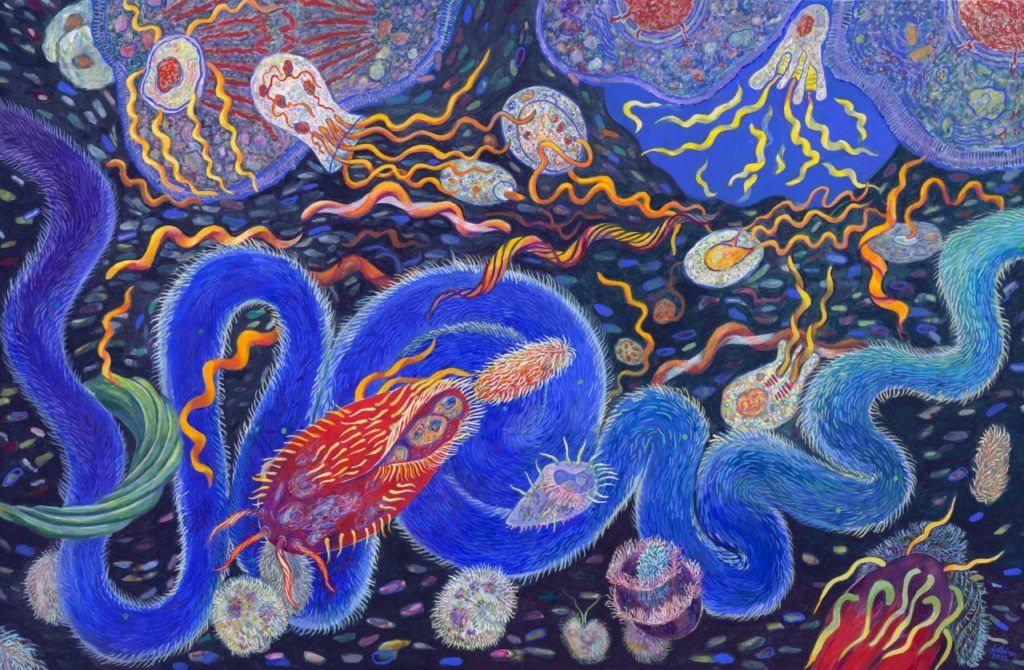
«Endosymbiosis, tribute to Lynn Margulis», Shoshanah Dubiner, 2012, www.cybermuse.com
Perhaps it is time to write a “Chthulucene Manifesto.” “My” Chthulucene is the time of mortal compositions at stake to and with each other. This epoch is the kainos (-cene) of the ongoing powers that are terra, of the myriad tentacular ones in all their diffracted, webbed temporalities, spacialties, and materialities. Kainos is the temporality of the thick, fibrous, and lumpy “now,” which is ancient and not. The Chthulucene is a now that has been, is now, and is yet to come. The Chthulucene is a relentlessly diffracted time-space (remember Karen Barad on quantum fields in Meeting the Universe Halfway). These powers surge through all that are terra. They are destructive/generative and in no one’s back pocket. They are not finished, and they can be dreadful. Their resurgence can be dreadful. Hope is not their genre, but demanding response-abilities might be. Terran forces will kill fools who provoke without ceasing. Killed but not gone, these fools will haunt in tentacular ongoing destruction.
The chthonic powers, both generative and destructive, are kin to Bruno Latour’s and Isabelle Stengers’s Gaia, even though their Gaias are not at all identical to each other. But for all three of us, Gaia and its kin are not mother; they are snakey gorgones like the untamed and mortal Medusa; they do not care about the thing that calls itself the Anthropos, the upward looking one. That upward-looking one has no idea how to go visiting, how to be polite, how to practice curiosity without sadism (remember Vinciane Despret and Hannah Arendt). In the Anthropocene (a naming I have come to need too), the chthonic entities can and do join in accelerating double-death provoked by the arrogance of the industrializers, super-transporters, and capitalizers, in seas, lands, airs, and waters. In the Anthropocene the tentacular ones are nuclear and carbon fire; they burn fossil-making man, who obsessively burns more and more fossils, making ever more fossils in a grim mockery of earth’s energies. In the Anthropocene, the chthonic ones are active too; all the action is not human, to say the least. And, written into the rocks and the chemistry of the seas, the surging powers are dreadful. Double death is in love with haunted voids.
The chthonic ones can and do infuse all of terra, including its human people, who become-with a vast motley of others. All of these beings live and die, and can live and die well, can flourish, not without pain and mortality, but without practicing double death for a living. Terran ones, including human people, can strengthen the resurgence (Anna Tsing’s kind) of vitalities that feed the hungers of a diverse and luxuriating world. The Chthulucene was, is, and can still be full of what Anna calls ‘Holocene resurgence’, or ‘feral biologies’—i.e., of the ongoingness—of a wild, cultivated and uncultivated, dangerous, but plentiful earth for always evolving critters including human people. Mixed and dangerous, the Chthulucene is the temporality of our home world, terra. The Chthulucene is never one; it is always sym-chthonic, not auto-chthonic, sympoietic, not autopoietic. All of us who care about recuperation, partial connections, and resurgence must learn to live and die well in the entanglements of the tentacular without always seeking to cut and bind everything in our way. Tentacles are feelers; they are studded with stingers; they taste the world. Human people are in/of the holobiome of the tentacular, and the burning and extracting times of the Anthropos are like monocultural plantations and slime mats where once forests, farms, and coral reefs flourished, which were allied to fungal materialities and temporalities in very different ways.
The Anthropocene will be short. It is more a boundary event, like the K-Pg boundary (Cretaceous-Paleogene boundary), than an epoch. Another mutation of the thick Kainos is already coming. The only question is, will the brevity of the Anthropocene/Capitalocene/Plantationocene “boundary event” be because double death reigns everywhere, even in the tombs of the Anthropos and his kin, or because multi species entities, including human people, made potent alliances in time with the generative powers of the Chthulucene, to power resurgence and partial healing in the face of irreversible loss, so that rich worldings of old and new kinds took root? Compost, not posthuman…
The Chthulucene is full of storytellers. Ursula LeGuin is one of the best, in everything she wrote. Hayao Miyazaki is another; remember Nausicaä of the Valley of the Wind. And then go to the Inupiaq online game Never Alone. Watch the trailer! (1)
With these storytellers, my next manifesto must be Make Kin Not Babies!
The Laboratory Planet collective explores new narratives of resilience
The Laboratory Planet collective is currently studying systems theory, collective resilience and stories of regeneration.
For the past three years, the art and research collective Laboratory Planet has been examining objects and modes of thought associated with the Anthropocene. The hypotheses explored in this text apply to modes of establishing reality through systemic thinking, which forms the intellectual infrastructure of the Anthropocene. They apply simultaneously to certain concepts that have become the kingpins of systemic thinking in the age of radical ecological, economic and social crises: resilience and regeneration. Finally, they apply to the collective itself as a form and matrix of resilient management, which in turn involves putting into action regenerative capacities.
The Anthropocene and modes of establishing reality through systemic thinking
The Anthropocene is defined as the geological era during which, due to the exponential increase in fossil fuel energy consumption following the industrial revolution, humanity has a major geological and environmental impact—in proportions that irreversibly upset environmental and ecosystemic balances on a scale unseen in millennia, leading to major economic and social disruptions in the near future: a decline in the fossil fuel-based energy system, which constitutes the energy infrastructure of globalization; disruption of vital geochemical cycles (carbon, phosphorus, sulfur, nitrogen); depletion of natural resources; extinction of species; acidification of oceans; exhaustion of soils; scarcity of fresh water.
Thus qualified, the Anthropocene is about systems. And it’s from a systemic viewpoint that we can hope to correct or reduce our impact.
In a systemic approach to the Earth, location is inconsistent; it is subordinate to the global, which gives meaning and orientation to all locations. The slogan of sustainable development—“act local, think global”—is not an adequate response to the disaster. Reducing local externalities is useless if in parallel the global accumulation of externalities is out of control. The “solution” is then to reinforce the consistency and application of an engineering vision. This leads to different ways of modeling the Earth or environments that are, in the end, interdependent. So how is a rural location still an object that is capable of responding to issues raised by the Anthropocene?
Dennis Meadows, systemic thinker and co-author of The Limits to Growth (1972), declares that today, it is too late for thermo-industrial societies to implement sustainable development and urgently advocates building resilient micro-systems to prepare for the shocks that lie ahead. Meanwhile, he questions the capacity of a macro-systemic approach to resolve the problems posed by thermo-industrial societies. But in both macro- and micro-systemic approaches, systemic vision informs the overall vision, which constitutes the intellectual infrastructure of the Anthropocene. The limits of this approach, however, are well documented.
Here we tackle this double systemic perspective of the Earth. While the naturalist approach has the advantage of describing, simply, the great geochemical cycles, which apply to all, or the metabolism of resilient micro-systems, it doesn’t cover the social, economic and cultural dynamics that are intrinsically linked. Everything happens as if the solution lies in a surplus of engineering or scientific rationality. From a systemic perspective, the social world is presented too simply, objectified and quantified, ruled by causal laws, and therefore likely to interface and coordinate with natural sciences through input and output flows. How does situated cultural and social reality challenge the clarity and simplification of the systemic approach? How does it open other ways of doing, acting and thinking in the Anthropocene? How does it offer an alternative view of the present, for which the very term Anthropocene seems inadequate?
For the past few years, Laboratory Planet has examined these questions. First, we collectively researched the planet as factory and as laboratory, the experiments on 1:1 scales, especially experiments in geo-engineering. The theme of our last issue was what we called the possibility of “alien capitalism”, in order to designate this breaking away from conditions that had up until now been considered natural. Various new objects—biological, economic, spatial, ideological, etc.—radically “a-terrestial” or even “extra-terrestrial” objects have appeared as technoscientific capitalism has developed, questioning the evidence of Earthlings’ attachment to the Earth, their geochthonian attachment, or at least of a significant number of them.
The macro-systemic perspective, which escapes the immersive vision to produce a synthetic vision of the Earth, intersects with the invention of the zenithal image of the “blue planet” as photographed 50 years ago, just as systems theory was introduced. This conquest of the sky, of synthetic vision, seems to have abrogated the land-view vision of those who practice the Earth as sensitive organisms.
At this level is deployed a systemic approach, often incremental and not at all scalable, but which implements local or situated practices of regeneration, adapted to the variations and interlacing of heterogeneous components, at once sensitive, biological, social, ecosystemic, industrial, commercial, cultural.
“Blue Planet”, one of the first photographs of the Earth taken by the astronaut Bill Anders during the Apollo 8 mission on December 24, 1968. Public domain.
Imagining regeneration
The concept of resilience has many meanings and uses in various fields. It refers to the capacity to recover from a shock, whether the shock is economic, social, ecosystemic or organic. It also refers to the capacity to absorb a shock or adapt to it. As such, this concept is one of the tools of systemic thinking that seeks to model abrupt changes.
Regeneration is the next phase: the capacity not only to recover from a shock but also to restore the initial state of a destroyed ecological or social condition. It differs from sustainable development by aiming not for balance, a theoretical zero-impact, but rather to “repair” the biosphere.
It’s at this specific point that radically different attitudes have emerged. At first, repair seems to refer to geo-engineering, the capacity to reform a planet that is understood as both a system and a machine. This vision of the Earth as a repairable system translates into other fields: regenerative urbanism, regenerative food, agriculture. In each case, it’s about restoring an initial state that has been destroyed or replacing it with an equivalent state. However, nobody believes that it’s possible to “repair” the damage of the Anthropocene, to return to the Holocene. There exists no method to restore the primary habitats that have been degraded. Only hybrid ecosystems, whose changes are reversible, can be restored.
And it’s a different story with living organisms. The body is constantly regenerating itself, as each of its 100 billion cells is gradually replaced. The heart is regenerated every 20 years. Each bone in the body is regenerated every 10 years. Nails regenerate every 6 to 10 months. The liver is regenerated every five months. Blood cells regenerate every four months. Skin regenerates every four weeks. These regenerative capacities of the metabolism are actively studied in various disciplines, in particular through research on the regeneration of tissues in marine biology.
But the concept of regeneration extends beyond its descriptive use. The philosopher Donna Haraway uses the term as a lever to dismantle the reproductive logic of the military-industrial complex. Here we find a point of tension between the reproductive logic of the systemic management of spaces such as in precision agriculture (optimizing the exploitation of large agricultural surfaces by using drones and satellites) and the regenerative logic of collective and citizen management of the territory, which, instead of modeling (reproductive logic), restores operations—like a salamander that, after losing a limb, regrows structures by pairing with other topographical productions on the site of the injury. The garden in a crisis area, like the regenerating limb, can be monstrous, polluted. It adjusts to local tensions and institutional constraints.
Collective resilience and resilience by the collective
What modes of resymbolization and storytelling exist today, amidst an increasing atmosphere of insecurity, vulnerability and helplessness in the Anthropocene? Our perspective responds to the extreme with regeneration and forming a collective culture.
Unlike the prophecy, collective culture, and by extension the culture of commons, need not be a tragic narrative, or the synoptic vision of an uncertain, confusing and obscure world—the world of the Anthropocene—radically objectified and all the more foreign. Concrete, situated, this culture of commons experiments with the art of making this uncertain and dangerous world habitable—socially but also ecologically, culturally, technically habitable. This collective art is also an art of the collective, not a monopoly of artists but spread out among scientific, social, agricultural, cultural, technical fields.
In a systemic approach, the art of the collective refers first to what Meadows calls resilient micro-systems: systems that must be urgently created in order to face the upcoming shocks. This is what is being experimented in working gardens that have proliferated in the interstices of cities lacking clear governance and a vision for the future. The other side of the collective takes action in systemic infrastructures, whether by investigating cultural and social singularities, or in a very different way, by reappropriating ecosystem monitoring devices through collective and citizen management of the territory (as with citizen sensors).