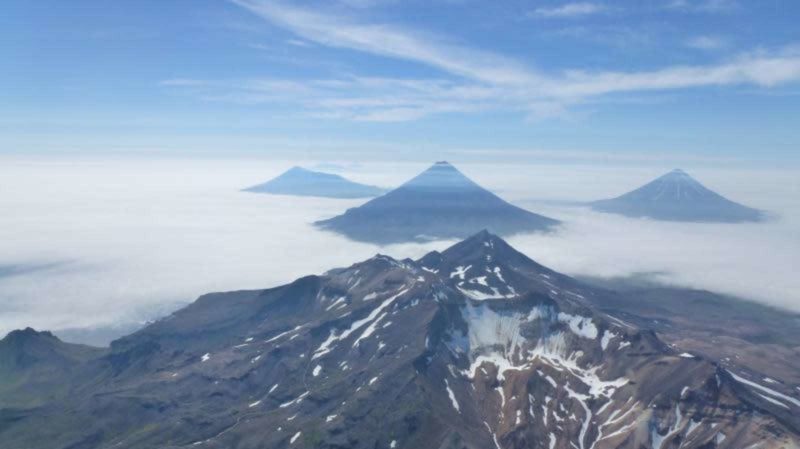
Como se já não tivéssemos notícias perturbadoras o suficiente em 2020, aí vem mais uma: geólogos agora têm motivos para suspeitar que um aglomerado de ilhas do Alasca é, na verdade, parte de um gigantesco sistema vulcânico interconectado, do mesmo tipo visto no Parque Nacional de Yellowstone.
Chamado de Ilhas das Quatro Montanhas (IFM), o arquipélago vulcânico está localizado ao longo da cadeia de ilhas Aleutas. Uma nova pesquisa liderada por John Power do U.S. Geological Survey no Alaska Volcano Observatory apresenta evidências de “uma grande caldeira não reconhecida anteriormente” no IFM, em pesquisa que será apresentada nesta segunda-feira (7) durante o Encontro de Outono de 2020 da União de Geofísica dos Estados Unidos (AGU).
O aglomerado consiste em seis estratovulcões bem espaçados, chamados Cleveland, Carlisle, Herbert, Kagamil, Tana e Uliaga. Estratovulcões são exatamente aquilo que você está pensando: vulcões enormes em montanhas altas e íngremes cobertas por um cone fumegante. A região também é intercalada com um monte de cones menores e fissuras. Das seis montanhas, Cleveland foi a mais ativa nas últimas duas décadas, criando nuvens de cinzas que atingem entre 4,5 e 9 metros.
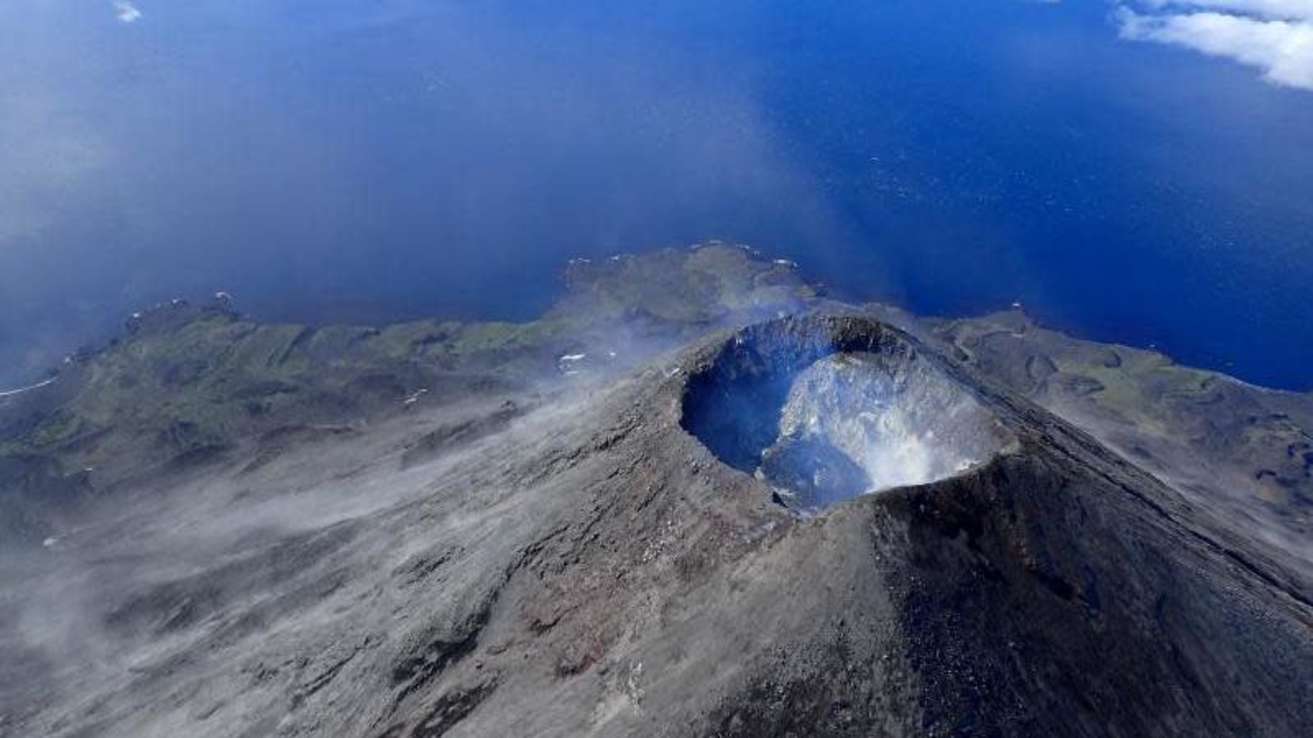
A cratera do Monte Cleveland. Imagem: Cindy Werner/USGS
A suposta caldeira não foi detectada por muito tempo porque está escondida por depósitos recentes e pelo oceano. E, de fato, não foi fácil para esses geólogos reunir suas evidências. Elas só foram possíveis por meio da análise de depósitos geológicos, mudanças na região ao longo do tempo, emissões de gases e medições de gravidade (que indicam a densidade das rochas enterradas), entre outras pistas. O IFM, ao que parece, está sendo influenciado por esta caldeira previamente não detectada.
Para ser claro, não está provado que as ilhas IFM fazem parte de uma caldeira. É um palpite forte que agora precisa ser reforçado por outras observações.
“Nossa esperança é voltar às Ilhas das Quatro Montanhas e olhar mais de perto o fundo do mar, estudar as rochas vulcânicas com mais detalhes, coletar mais dados sísmicos e gravitacionais e amostrar muito mais áreas geotérmicas”, explicou Diana Roman, coautora do estudo e geóloga do Carnegie Institution for Science em Washington.
Caldeiras são câmaras subterrâneas enormes cheias de magma e são conhecidas por produzirem algumas das erupções mais catastróficas da história do nosso planeta. Em comparação, estratovulcões são acompanhados por bolsões minúsculos de magma. E, de fato, eles são frequentemente chamados de supervulcões por esse motivo.
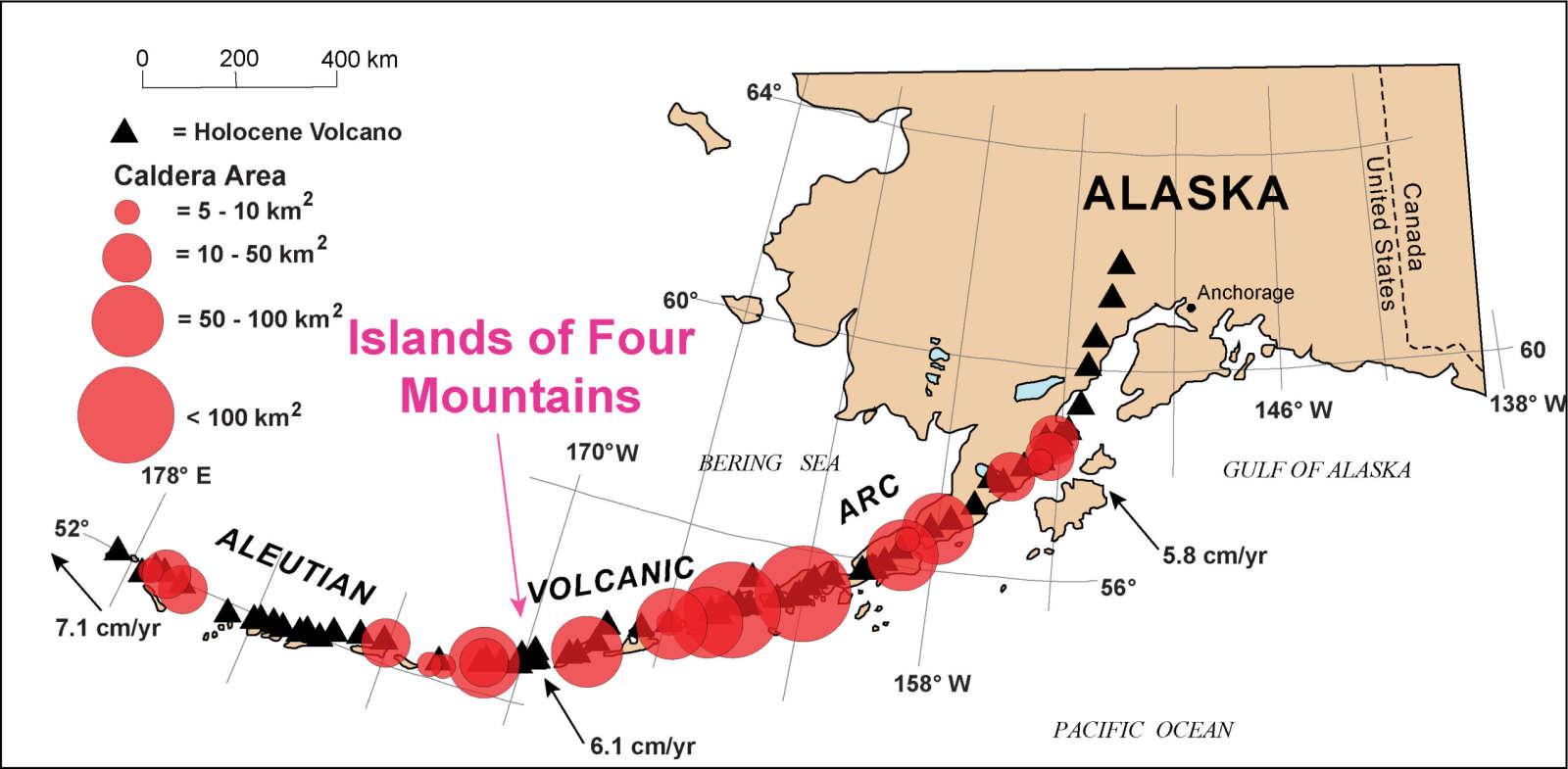
Cada ponto em vermelho representa uma caldeira no arquipélago de Aleutas. Imagem: John Power/USGS
Yellowstone é provavelmente a caldeira mais reconhecível da Terra, devido ao seu tamanho e potencial ameaça. Não se espera que entre em erupção tão cedo, mas se acontecer, a caldeira derramará lava sobre uma região que se estende por 48 a 64 km. Essas erupções também podem produzir grandes quantidades de cinzas, o que pode alterar o clima no planeta como um todo. Carregado pelo vento, o aerossol de enxofre e as partículas de cinzas leves causariam “uma diminuição notável nas temperaturas ao redor do globo”, de acordo com o U.S. Geological Survey.
A possível caldeira no IFM provavelmente não se iguala ao Parque de Yellowstone em termos de tamanho ou ameaça, e muitas outras caldeiras já foram confirmadas nas Aleutas. Contudo, isso não é motivo para subestimar o perigo representado por essas características geológicas. Essa é uma descoberta muito séria e, eventualmente, os geólogos podem ter que reclassificar os vulcões IFM. O gigantesco sistema vulcânico interconectado pode explodir no futuro e com “graves consequências globais”, segundo a AGU.
Além de alterar o clima, grandes erupções também podem resultar em mudanças sociais significativas. Como, por exemplo, em 43 aC, quando o vulcão Okmok do Alasca, que é alimentado por uma caldeira, explodiu. Pesquisas recentes sugerem que essa erupção foi uma das principais causas que levou à queda da República Romana e do Reino Ptolomaico no que hoje é o Egito. Então, não é brincadeira mesmo.
In
November Mount Agung on Bali erupted, sending plumes of smoke and ash
30,000 feet into the air and shutting the popular holiday island’s only
airport. More than 400 flights a day were cancelled until Denpasar
reopened.
Last month eyes turned to Hawaii, where Kilauea, said to be
continuously simmering, blew violently, spewing out lava flows, cracking
the earth and spitting out rock projectiles. The volcano remains on
high alert.
Now, Fuego in Guatemala is the latest to erupt, killing at least 25 people and injuring hundreds more in the most violent eruption in the central American country in decades.
Three days of national mourning have been declared after the volcano
hurled rocks, smoke and ash into the sky. El Rodeo, a village nearby,
has been all-but destroyed by a flow of lava.
Fuego erupted on Sunday in GuatemalaCredit:
Getty
Are volcanoes getting more active?
According to the National Museum of Natural History’s Global
Volcanism Program, more than 1,500 volcanoes on the planet have erupted
at some point in the last 11,500 years, the current geological epoch
otherwise known as the Holocene period.
Today, some 15 are erupting, a figure common for any given point in modern history.
Clive
Oppenheimer, professor of volcanology at the University of Cambridge,
says there has not been an increase in volcanic activity.
“There have been quite a few eruptions in the news lately, so people
question whether there’s an increase in rates of volcanism that we’re
seeing just now, and this isn’t really the case,” he said.
“Eruptions are happening all the time - some make the news headlines and others don’t.
The ongoing eruption on Kilauea in Hawaii as captivated audiences around the worldCredit:
REUTERS/TERRAY SYLVESTER
“If we look at the statistics back in time, the main thing we see is a
reporting bias. There are not many eruptions during World War Two, for
example, when people had other things to really worry about.
“So of course things will flare up in one place or another place and
then it will be very much how those eruptions affect people and where
abouts in the world [as to] whether that then becomes newsworthy.”
Can we predict which volcano will blow next?
According to an article published late last year by a trio of volcanologists on
the Conversation, there are six volcanoes “showing signs of unrest” and
in need of monitoring. Among them was Kilauea, on Hawaii, which erupted
last month.
Oppenheimer, who made documentary film Into the Inferno with
Werner Herzog in 2016, said monitoring of volcanoes has become
incredibly sophisticated, but science can only predict so much.
“In Hawaii, in Indonesia, in Italy, where there are volcanoes known
to erupt, there are agencies, institutes, observatories, that are doing
24/7 monitoring, measuring the earthquakes occurring on volcanoes,
looking at the changing shapes of the volcano and looking at the gas
emissions, so it’s possible to make some sort of assessment of what the
volcano might be gearing up to in the future,” he said.
“Of course, [the next big eruption] is likely to be in the a volcanic
region that we already know about. But I think one of the lessons of
history, even recent history, is the really big eruptions have not
happened at volcanoes that scientists were looking at.
“We tend to focus on volcanoes that have erupted in recent times but
the really big events can happen at volcanoes that have been quiet, that
have been dormant for many centuries or even millennia. They’ve been
biding their time, building up a reservoir of magma in the crust.”
He cited the eruptions of Mount Pinatubo in the Philippines in 1991,
El Chichon in Mexico in 1982 and Chaiten in Chile in 2008 as volcanoes
that were not on the scientific radar yet produced very large eruptions.
“That’s something we should keep in mind going forward,” he said. “It
might not be a volcano that’s currently well monitored that will lead
to the next major volcanic eruption.”
Oppenheimer says the pressure on scientists to monitor and predict
the behaviour of volcanoes is equal to that of communicating the threat
to the public.
“This where the really important work is needed,” he said. “The
science can be fantastic. We never have certainty in predicting volcanic
eruptions but we might have some reasonable evidence.
“If you can’t communicate that to the population at risk, to the
civil protection authorities that need to start an evacuation, then all
the science is useless.”
Will climate change lead to more volcanic eruptions?
A 2017 study published in the Geology journal researched a
link between melting glaciers and ice caps and an increase in volcanic
activity. Looking at a period of cooling about 5,500 years ago in
Iceland, the researchers found that growing ice coverage coincided with a
decrease in eruptions. The same was true in reverse: when the ice
retreated, the number of eruptions increased.
As the world’s ice sheets shrink and glaciers melt, it has been
suggested the retreat could usher in a new era of volcanic activity.
Oppenheimer explained the link between ice ages and rates of volcanism.
“We do see effects with deglaciation of the last ice age with the
relatively sudden unloading of volcanic regions that might have been
under two to three kilometres of ice,” he said. “When that is moved that
can cause melting that fuels volcanoes, it can trigger eruptions, and
that leads us to the question well then what about the future, as we are
seeing global warming and more deglaciation.
“But it’s something one could only really study from the point of
view of models perhaps, but also from statistics so you’d really want
lots and lots of data.
“I think we can kind of do that when we look back at the end of the
last ice age, but as we’re going forward in the next century, I don’t
think we will see any kind of statistical blip related to anthropogenic
climate change today.”
Mount Agung, Bali, smokes in the backgroundCredit:
Getty
Why are volcanoes dangerous?
Given that some volcanoes are constantly simmering, or that many
eruptions go unnoticed every year, it might be difficult to put a finger
on exactly how many volcanoes are dangerous.
In Hawaii, the lava flows mainly drained into the sea, while the
volcano spat some projectiles across the nearby surroundings. In
Guatemala, lava flows seemed to have caused destruction. But there are
many ways volcanoes can impact a country, region, or indeed, the world.
Show more
Oppenheimer cites mud flows and pyroclastic flows - “hot ash, and
rock and pumis [that] has been blasted up into the atmosphere [and]
collapses back to the ground and flows as a kind of hurricane-like
current down the flanks of the the volcano” - as two of the more
destructive results of an eruption.
But he also cites the impact on vegetation and livestock from gas
emissions. In 1815, after the eruption of Tambora in Indonesia, one of
the most powerful eruptions in recorded history, there followed in 1816
the Year Without a Summer after ash from the eruption spread around the
world lowering global temperatures, sparking extreme weather and causing
harvest failures.
“In the future, we can’t rule out a very great eruption of that
scale,” he said. “The same sulphur release as Tambora in 1815 might
[today] also have repercussions on global food security.”
Where are all the world’s volcanoes?
The majority are found in clusters, or strips, mostly following the
faultlines of the world’s tectonic plates. For this reason, mapping the
world’s volcanoes according to country is slightly misleading, as most
are linked to the same geological highway.
The "Ring of Fire" that encircles the Pacific Ocean – which stretches
up the west coast of the Americas, around and across to Asia, looping
down to the east of Japan, before overwhelming much of Indonesia and the
Philippines and whipping around Australasia – boasts the most, with
452.
This is why Indonesia has the third most volcanoes in the world, at
139. The island of Bali has three: Agung, Batur and Buyan-Bratan. Japan
comes fourth with 112. Chile (also on the Ring of Fire, on the cusp of
the South American plate) is fifth, with 104.
But it is the United States that takes the title with the most, 173,
followed by Russia, with 166 – both large countries, and also both on
the Ring of Fire.
The 10 countries with the most volcanoes
United States - 173
Russia - 166
Indonesia - 139
Japan - 112
Chile - 104
Ethiopia - 57
Papua New Guinea - 53
Philippines - 50
Mexico - 43
Argentina - 39
Another hotspot for volcanoes is on the African continent, where the
African Plate meets the Arabian Plate, which is why Kenya (23), Tanzania
(10) and Ethiopia (57) boast a wealth of volcanoes.