
https://www.sciencealert.com/black-hole-event-horizon-accretion-disc-jean-pierre-luminet-event-horizon-telescope

The year 2019 is here. With it, we've been promised a splendid moment in astronomy. For years, the Event Horizon Telescope has been working to bring us the first ever telescopic photograph of the event horizon of a black hole.
Indeed, for all their popularity in public imagination, we have never actually seen a black hole. And the reason for that is laughably simple.
Black holes, you see, are literally invisible. The pull of their gravity is so immense that, past a certain point, nothing escapes. This includes the electromagnetic radiation - such as X-rays, infrared, light and radio waves - that would allow us to detect the object directly.
That point of no return is called the event horizon, and apart from being a terrifying location you never want to find yourself in, it's also our key to actually visualising a black hole.
While we may not be able to see the black hole itself, there's a chance that its event horizon can be photographed; and we are tantalisingly close to seeing the results thanks to the Event Horizon Telescope (EHT), due for a public announcement any day now.
But long before the EHT, there was an astrophysicist named Jean-Pierre Luminet. All the way back in 1978, he already gave us what could be thought of as the very first image of a black hole's event horizon.
It's not, of course, an actual photo. Luminet, whose background
was in mathematics, used his skillset to perform the first computer
simulation of what a black hole might look like to an observer, using a
1960s punch card IBM 7040 computer.
"At the time it was a very exotic subject, and most astronomers did not believe in their existence," Luminet told ScienceAlert.
"I wanted to explore the strange physics of black holes and propose specific mechanisms that could help to get indirect signatures of their very existence. Also, to pursue the pun, with my name 'Luminet' I liked much the idea of how a perfectly non-luminous star can give rise to observable phenomena."
What data the computer returned, Luminet then painstakingly plotted by hand with pen and India ink on negative paper, as if he were a human printer.
That fuzzy image - seen above - shows what a flat disc of material falling into a black hole might look like if we were close enough to see it. It doesn't look flat, because the intense gravity of the black hole is bending light around it.
"Indeed the gravitational field curves the light rays near the
black hole so much that the rear part of the disk is 'revealed',"
Luminet explained in a paper published on arXiv last year.
"The curving of the light rays also generates a secondary image which allows us to see the other side of the accretion disc, on the opposing side of the black hole from the observer."
Luminet was the first, but he wasn't the only one captivated by the mystery of what a black hole might look like. Others have attempted to visualise these objects since then, and even put their efforts on the silver screen.
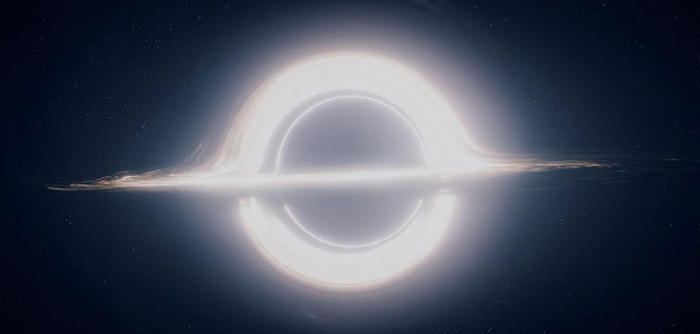 Interstellar's black hole Gargantua. (Paramount Pictures)
The 2014 Christopher Nolan film Interstellar was lauded for its supposedly "scientifically accurate" depiction of a black hole, based in large part on the work conducted by Luminet decades earlier, and created in consultation with theoretical physicist Kip Thorne of Caltech.
Ultimately, the film opted for a simplified version, to be less confusing and look pretty on screen.
It was certainly impressive; but, according to both Luminet and Thorne, it's not really what a black hole would look like.
The primary and secondary images created by the gravitational field are present and correct. But, unlike Luminet's image, the disc's brightness is uniform.
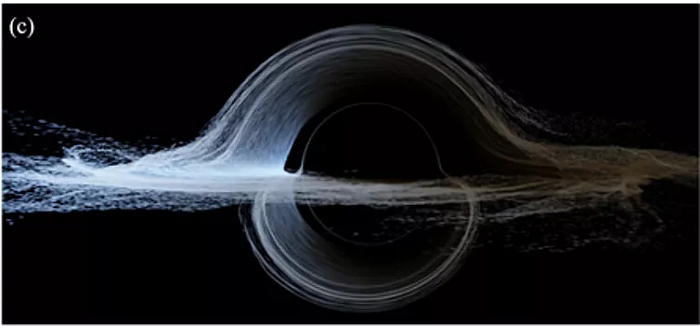 A
simulation of a black hole from a paper by Thorne and colleagues on the
CG techniques used to develop Gargantua. (James et al./Classical and
Quantum Gravity)
A
simulation of a black hole from a paper by Thorne and colleagues on the
CG techniques used to develop Gargantua. (James et al./Classical and
Quantum Gravity)
"It is precisely this strong asymmetry of apparent luminosity," Luminet wrote, "that is the main signature of a black hole, the only celestial object able to give the internal regions of an accretion disk a speed of rotation close to the speed of light and to induce a very strong Doppler effect."
He penned a 15-page paper on the film's science, and Thorne himself wrote a book on the topic.
You may notice that all of these versions of a black hole look very different from another type of black hole image you may have seen, most famously for the LIGO discovery in 2016.
These are based on the work of astrophysicist Alain Riazuelo, of the French National Centre for Scientific Research and International Astronomical Union, who first simulated such a black hole in 2016.
The reason these black holes look different is because the artwork shows a quiescent black hole - one without an accretion disc.
The EHT has been focusing on Sagittarius A*, the supermassive black hole at the centre of our own galaxy, the Milky Way.
We don't know what we're going to see; it's possible that the data will only return a few blurry pixels. (If that's the case, more telescopes will join the collaboration, and the scientists will try again.)
Given the black hole had an accretion disc during observations, we're anticipating something that looks a lot like the work of Luminet.
In addition, the collaboration will hopefully help us understand more about the polarisation of radiation, the structure of the magnetic field, and the black hole's relativistic jets. It's already yielded up clues about the structure of space around the black hole.
But what's the most exciting part about the work of the EHT? We're totally with Luminet on this one.
"The photo of the accretion disc!" he said. And we can hardly wait.

The First-Ever Photo of a Black Hole Is Almost Ready. Here's What It Might Look Like
Indeed, for all their popularity in public imagination, we have never actually seen a black hole. And the reason for that is laughably simple.
Black holes, you see, are literally invisible. The pull of their gravity is so immense that, past a certain point, nothing escapes. This includes the electromagnetic radiation - such as X-rays, infrared, light and radio waves - that would allow us to detect the object directly.
That point of no return is called the event horizon, and apart from being a terrifying location you never want to find yourself in, it's also our key to actually visualising a black hole.
While we may not be able to see the black hole itself, there's a chance that its event horizon can be photographed; and we are tantalisingly close to seeing the results thanks to the Event Horizon Telescope (EHT), due for a public announcement any day now.
But long before the EHT, there was an astrophysicist named Jean-Pierre Luminet. All the way back in 1978, he already gave us what could be thought of as the very first image of a black hole's event horizon.
"At the time it was a very exotic subject, and most astronomers did not believe in their existence," Luminet told ScienceAlert.
"I wanted to explore the strange physics of black holes and propose specific mechanisms that could help to get indirect signatures of their very existence. Also, to pursue the pun, with my name 'Luminet' I liked much the idea of how a perfectly non-luminous star can give rise to observable phenomena."
What data the computer returned, Luminet then painstakingly plotted by hand with pen and India ink on negative paper, as if he were a human printer.
That fuzzy image - seen above - shows what a flat disc of material falling into a black hole might look like if we were close enough to see it. It doesn't look flat, because the intense gravity of the black hole is bending light around it.
"The curving of the light rays also generates a secondary image which allows us to see the other side of the accretion disc, on the opposing side of the black hole from the observer."
Luminet was the first, but he wasn't the only one captivated by the mystery of what a black hole might look like. Others have attempted to visualise these objects since then, and even put their efforts on the silver screen.
Interstellar's black hole Gargantua. (Paramount Pictures)The 2014 Christopher Nolan film Interstellar was lauded for its supposedly "scientifically accurate" depiction of a black hole, based in large part on the work conducted by Luminet decades earlier, and created in consultation with theoretical physicist Kip Thorne of Caltech.
Ultimately, the film opted for a simplified version, to be less confusing and look pretty on screen.
It was certainly impressive; but, according to both Luminet and Thorne, it's not really what a black hole would look like.
The primary and secondary images created by the gravitational field are present and correct. But, unlike Luminet's image, the disc's brightness is uniform.
A
simulation of a black hole from a paper by Thorne and colleagues on the
CG techniques used to develop Gargantua. (James et al./Classical and
Quantum Gravity)"It is precisely this strong asymmetry of apparent luminosity," Luminet wrote, "that is the main signature of a black hole, the only celestial object able to give the internal regions of an accretion disk a speed of rotation close to the speed of light and to induce a very strong Doppler effect."
He penned a 15-page paper on the film's science, and Thorne himself wrote a book on the topic.
You may notice that all of these versions of a black hole look very different from another type of black hole image you may have seen, most famously for the LIGO discovery in 2016.
These are based on the work of astrophysicist Alain Riazuelo, of the French National Centre for Scientific Research and International Astronomical Union, who first simulated such a black hole in 2016.
The reason these black holes look different is because the artwork shows a quiescent black hole - one without an accretion disc.
Denuded
of that shroud of dust and gas, the black hole's gravity warps the
space behind it; if we were close enough to be seeing the black hole
like this, we would be in motion, captured by its gravity in orbit. This
is why it appears to move across the field of stars.
In the case
of two black holes together, as seen in the LIGO video, each black hole
has a small banana-shaped secondary image of the other hole appearing
behind it. (Gravity is neat.)We don't know what we're going to see; it's possible that the data will only return a few blurry pixels. (If that's the case, more telescopes will join the collaboration, and the scientists will try again.)
Given the black hole had an accretion disc during observations, we're anticipating something that looks a lot like the work of Luminet.
In addition, the collaboration will hopefully help us understand more about the polarisation of radiation, the structure of the magnetic field, and the black hole's relativistic jets. It's already yielded up clues about the structure of space around the black hole.
But what's the most exciting part about the work of the EHT? We're totally with Luminet on this one.
"The photo of the accretion disc!" he said. And we can hardly wait.


